





Which species will inherit the Earth if humans become extinct?
28.01.2016 23:30


In a post-apocalyptic future, what might happen to life if humans left the scene?
After all, humans are very likely to disappear long before the sun expands and exterminates all living things from the Earth.
So if we were given the chance to peer forward in time some 50 million years after our disappearance, what would we find?
Here, writing for The Conversation, Luc Bussiere, lecturer at the University of Sterling explains the odds of other species inheriting the Earth, and why its unlikely to be primates.
The question has inspired a lot of popular speculation and many writers have offered lists of candidate species.
Before offering any guesses, however, we need to carefully explain what we mean by a dominant species.
One could argue that the current era is an age of flowering plants.
But most people aren't imagining Audrey Two in Little Shop of Horrors when they envision life in the future - even the fictional triffids had characteristically animal features, predatory behaviour and the ability to move.
So let's keep the discussion to animals.
By some standards the world is now, and always has been, dominated by bacteria despite the nominal end of the 'age of microbes' some 1.2 billion years ago.
This was not because bacteria ceased to be, or declined in prevalence, but rather because in our myopia we tend to place more importance on the large multi-cellular organisms that came after.
By some accounts, four out of five animals is a nematode - a roundworm - so from all these examples it's clear that neither prevalence, abundance nor diversity is the prime requisite for being a 'dominant' form of life.
Instead our imaginations are captured by large and charismatic organisms.
There's an undeniable degree of narcissism in the human designation of dominant species and a strong tendency to award the title to close relatives.
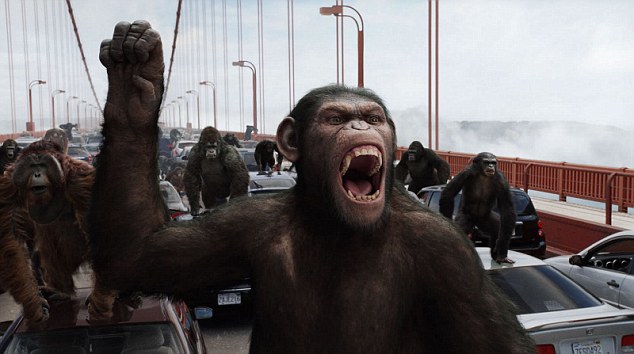
The Planet of the Apes imagines that our closest primate relatives could develop speech and adopt our technology if we gave them the time and space to do so.
But non-human primate societies are unlikely to inherit our dominance of the earth, because the apes are likely to precede us to extinction.
We are already the only living hominid that's conservation status is not endangered or critically endangered and the kind of global crisis that would extinguish our species is unlikely to spare the fragile remaining populations of the other great apes.
In fact, any extinction event that affects humans will probably be most dangerous to organisms that share our basic physiological requirements.
Even if humans succumb to a global pandemic that affects relatively few other mammals, the great apes are precisely the species that are most at risk of contracting any new diseases that drive us from the Earth.
Will another, more distant, relative develop intelligence and human-like society? That too seems unlikely.
It follows that such traits are neither requirements for being dominant among animals, nor particularly likely traits to evolve.
Evolution does not favour intelligence for its own sake, but only if it leads to higher survival and reproductive success.
Consequently it's a profound mistake to imagine that our successors are likely to be especially intelligent or social creatures, or that they will be capable of speech, or adept with human technology.
So what can we safely speculate about the dominant species, some 50 million years after humanity?
The answer is both dissatisfying and thrilling all at once.
While we can be reasonably confident that it won't be a talking chimpanzee, we otherwise have no idea what it will look like.
The world has seen a number of mass extinction events in the course of its history.
The diversification of life following each event was relatively rapid - and the 'adaptive radiation' of new species produced new forms including many unlike the ancestral lineages that spawned them after surviving the prior extinction.
(http://www.dailymail.co.uk/sciencetech/article-3419324/Which-species-inherit-Earth-humans-extinct-Expert-reveals-possible-contenders-s-unlikely-ll-planet-apes.html)
www.ann.az


Facebook
Follow us on Facebook


Similar news
Similar news









Society 15:00
Helsinki Court Jails Fitburg Captain and Azerbaijani Boatswain Over Undersea Cable Damage



 Photo




 Video


