





Kepler telescope identifies ancient solar system
29.01.2015 14:30


An ancient solar system similar to our own has been discovered by scientists.
Studying data from the Kepler telescope, the team, led by the University of Birmingham, found a star orbited by five planets similar in size to Earth.
The system, 117 light years away, is the oldest known of its kind, formed 11.2 billion years ago.
Dr Tiago Campante said it could provide a clue to "the existence of ancient life in the galaxy".
"By the time the Earth formed, the planets in this system were already older than our planet is today," he said.
"This discovery may now help to pinpoint the beginning of what we might call the era of planet formation."
Researchers said the star, named Kepler-444, and its planets were two and a half times older than earth and dated back to the "dawn of the galaxy".
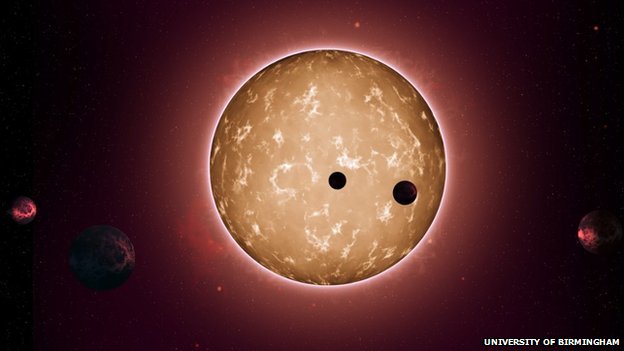
Artist's impression of Kepler telescope
Planets ranging in size from Mercury to Venus orbit the star within the equivalent of 10 of our days.
While the proximity of the planets to the star ruled out the possibility of life, Dr Campante said the discovery showed planets of an Earth-like size, capable of supporting life, could exist around a similarly ancient star.
"There may be civilisations out there with a head-start of a few billion years. Imagine the level of technology," he said.
Nasa's Kepler mission has so far found hundreds of new worlds since in launched in 2009.
Scientists have studied the occasional dips in light as planets pass in front of their host stars.
Scientists studied the natural resonance of Kepler-444, caused by the sound trapped within it, allowing them to measure its diameter, mass and age.
Dr David Gregory-Kumar, BBC Midlands Today
Planet hunting is one of the most exciting areas of astronomy. What was once thought of as science fiction is now a reality.
But what makes today's discovery by the University of Birmingham so interesting is that the astronomers have found ancient planets that are similar to those in our own solar system.
It means earth-like planets have been around for much of the 13.8 billion year history of the Universe.
This expands what we know about the early formation of planets and could even have implications for the potential for ancient alien life in our galaxy.
Meanwhile a new generation of planet hunting telescopes, including one led by the University of Warwick, are just coming online.
(BBC)
ANN.Az


Facebook
Follow us on Facebook


Similar news
Similar news









Society 15:00
Helsinki Court Jails Fitburg Captain and Azerbaijani Boatswain Over Undersea Cable Damage



 Photo




 Video


