





Ancient cannibals used chillies and spices to 'marinate' their victims
22.05.2015 22:30


A gruesome recipe has been uncovered that explains how ancient cannibals prepared their human meals.
Researchers have found that people living near what is now Mexico City, 2,500 years ago, grilled or boiled human flesh before seasoning it with chillies and saffron-like spices such as annatto.
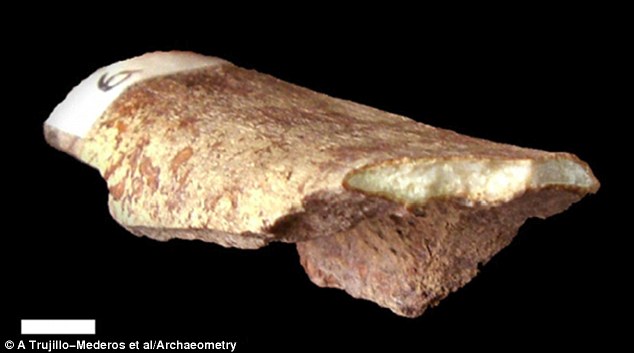
They were able to discern this by studying the colouration of the bones, which had been permanently stained with the exotic spices.
The bone fragments from skulls and long bones date to between 700 and 500 BC and have cut marks, facial mutilation and exposure to high temperatures, suggesting cannibalism.
But it is their red and yellow tinge that interested the experts and led them to uncover clues about how ancient cannibals prepared their food.
‘The colour must have been acquired before burial, either through thermal treatment, or through some organic dye,’ they wrote in the study.
Experts studied the microscopic structure, morphology and texture of the bones using techniques including X-ray diffraction and scanning electron microscopy to work out how the bones and flesh would have been cooked.
Distinguishing boiled bones from those that were grilled was a challenging task, but they found that microscopic changes in the bones’ textures revealed cooking techniques.
‘In boiled bones, the texture is homogenous and dark patches of inhomogeneous degradations are not observed.
‘This is the way, then, to distinguish boiling from grilling.’
They believe the intensely red bones belong to humans whose flesh was grilled, because meat juices and blood diffused into the bones as the temperature increased.
The bones that are yellow were boiled with spices including saffron-like annatto, pipián, which is still found in mole sauce, and chilli peppers.
The spicy mixture dyed the bones the distinctive ochre colour.
‘These condiments contain high amounts of carotenoids, which are well known as dying agents,’ the study said.
To test the findings, the experts boiled a cow bone in an annatto solution - an ingredient still used in Mexican cooking.
'The resulting bone presented the same colour as the archaeological bones, showing that the bone surface colour can be attributed to the cooking of savoury dishes,' they wrote.
'The differences in colour [of the bone fragments] have to be attributed to the cooking recipes used in Mesoamerica.
‘The surface colour of the Tlatelcomila boiled bones may be explained by a combined effect of temperature, cooking time and the composition of the cooking liquid soup.’
The study is important because it suggests cannibals in Mexico used similar recipes to prepare humans, as they did corn and other less gruesome ingredients than human flesh.
It does not specifically identify a group of people responsible for these cannibalistic acts, but it is not the first time evidence of cannibalism has been found in Mexico.
A group called the Xiximes reportedly believed they could guarantee a good harvest if they consumed the souls of their enemies - often fellow tribesmen from neighbouring villages - ate their bodies and hung their bones from trees as offerings to the spirits.
There had previously been no scientific evidence to back up those early accounts, often derided as hysterical exaggerations, but researchers in 2011 made a discovery of cooked and carved human bones dating back to 1425.
The stained bones are much older than this, but it suggests a long history of the gruesome activity.
At the time of the 2011 discovery, José Luis Punzo, an archaeologist with the Mexican National Institute of Anthropology and History (INAH) said cannibalism 'was a crucial aspect of their world view, their identity.
'Through their rituals, cannibalism, and bone-hoarding, they marked a clear boundary between an "us" and "them".'
The rituals were tied to the agricultural cycle of planting and sowing corn, according to the research reported in National Geographic.
After each harvest, the warriors of the Xiximes were sent to hunt for flesh, preying often on lone men working in isolated conditions in the pine forest region, some 8,530ft above sea level.
(dailymail.co.uk)
www.ann.az


Telegram
Follow us on Telegram


Similar news
Similar news








Society 15:00
Helsinki Court Jails Fitburg Captain and Azerbaijani Boatswain Over Undersea Cable Damage



 Photo




 Video


