





Stunning (yet worrying) photographs capture Greenland's disintegrating icecap
11.01.2016 22:30


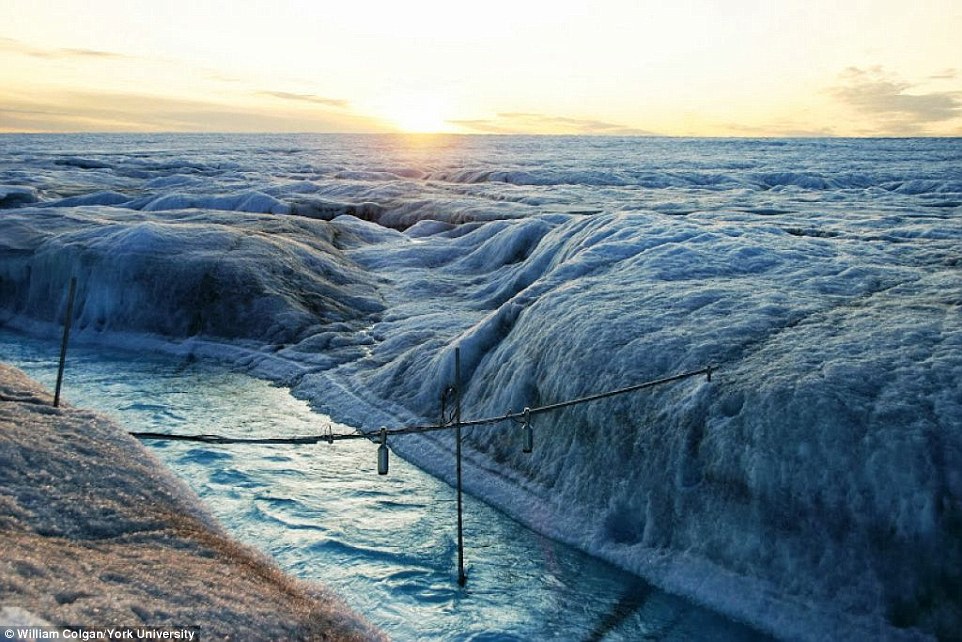
Photos of the melting icebergs in Greenland from a recent expedition are captivatingly beautiful but the meaning of the photographs are much more harrowing in nature.
Research from a 2013 trip contributed to the study led by Horst Machguth at the Geological Survey of Denmark and Greenland called 'Greenland meltwater storage in firn limited by near-surface ice formation.' Details from the study were published in Nature Climate Change this week.
The stunning photographs were provided by William Colgan who is an assistant professor in the Department of Earth and Space Science and Engineering at York University in Toronto, Canada.
The study determined that a greater than normal amount of melting in Greenland has caused the top firn of the ice to freeze into solid ice.
The firn layer generally absorbs 30n to 40 per cent of meltwater that makes contact with the ice sheet rather than pouring the water back into the ocean, according to CBC.
'That hadn't been seen before,' said William Colgan
'That was a very powerful visual, to see just how dramatically the firn had changed — to see no rivers one year, and the next year rivers extending an additional 20, maybe even 30kms inland.'
The increase in melting can cause rising sea levels and dangerous flooding and is already becoming a problem in some areas.
The Greenland ice sheet has already lost more than 9 trillion tons of ice in the past century and it's rapidly melting even more, according to The Washington Post.
'Now the firn is being capped off much faster than it's being recreated,' said Colgan.
'Evidence is emerging to show Canadian Arctic firn is also capping off,' Colgan added.
Collecting data in Greenland was difficult for Colgan and others who took part in the five week expedition in 2013.
The researchers camped out in unheated tents and huddled together for warmth.
They then spent their days calculating the volume, mass, and density of each layer of ice.
'll of that core logging is very tedious work and you're not moving around, and it's so cold out that you can just feel the heat leaving your toes as you work late into the night,' Colgan said of the journey.
(dailystar.co.uk)


www.ann.az


Twitter
Follow us on Twitter

Similar news
Similar news











 Photo




 Video


