




Why China's ruling party is bearing down on 'cliques'
06.01.2015 15:59


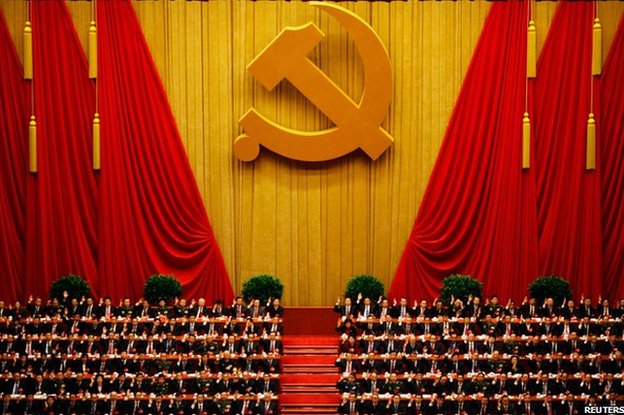
The Chinese Communist Party acknowledges the existence of dangerous cliques.
It is a rare public admission of the existence of factions within a Communist Party which has, for decades, preferred to project a façade of unbreakable unity.
An editorial in Monday's flagship newspaper, The People's Daily, says cliques are akin to parasites and are "harmful for both the country and the people."
The cliques in question are, it is suggested, intimately linked to the rampant and widespread corruption which is, of course, the target of President Xi Jinping's much-vaunted crackdown.
"Some cliques of officials are, in fact, parasitic relationships for the conveying of benefits," the editorial says.
Over the weekend, the Party-run Xinhua news agency even went as far as naming three of the cliques as well as some of the senior officials it said were connected to them.
"The Secretary Gang," it said, was a group of aides to senior officials, including some of the former personal secretaries of Zhou Yongkang, the once supreme head of China's domestic security apparatus and now himself under criminal investigation.
"The Petroleum Gang," were bureaucrats in China's oil industry, a sector also intimately linked to Zhou's patronage and political control.
And finally, "The Shanxi Gang," the newspaper claimed, were officials from the coal rich province, some of whom were linked to Ling Jihua.
Mr Ling is a native of Shanxi who, as a chief aide to the former President Hu Jintao, is another high profile political scalp to have been taken down in President Xi's purges.
This media tirade against the cliques appears to have been given the green light following a statement issued by the Communist Party Central Committee just before New Year.
It said a meeting, headed by President Xi, had determined that: "Organising cliques within the party to run personal businesses is absolutely not tolerated."
Mr Xi's battle against official graft is presented to the Chinese public as a simple fight to restore the virtues of good clean governance by honest officials.
In practice, of course, it is an exercise in which the Communist Party is cleaning out its own stables, on its own terms with no independent judicial scrutiny.
And in a one-party system, in which corruption is often regarded as the rule, not the exception, many are vulnerable and choices are likely to involve an element of political calculation.
So there has long been suspicion that the crackdown is being used as a tool by the president to consolidate power and to eliminate rivals including the retired, but still powerful, Zhou Yongkang.
Now, if anyone ever doubted it, this latest talk of factions only serves to enhance the whiff of political infighting.
Admittedly the editorials do not accuse the cliques of plotting directly for political power, only of building corrupt empires for economic gain.
Nonetheless, corruption - an ever-present spectre evoked by all administrations, not just this one - has usually been presented as a problem of individual, moral failing rather than one of a deeper, systemic rot.
So there is undoubtedly a political risk in raising the issue of factionalism but it is perhaps a carefully calculated one.
Precisely because the anti-corruption campaign has been given such political priority and is taking down such high profile figures it might be felt that a better explanation is now needed.
So the intensity of the war on corruption is justified and explained by a parallel war on "cliquism."
The fight now is not only against bad individuals, but against the much more sinister mafia-style networks that enable them.
And it can be presented as more proof of President Xi's increasing confidence and strengthening hold on power.
The Xinhua editorial hinted at the risks of taking down the party giants like Zhou but quoted President Xi as saying: "We have identified the mission and purpose of the party, as well as what people expect."
Others though will worry about dark echoes from the past.
"What does all this mean?" writes one Chinese internet user.
"Is it a return to the Gang of Four?" - a reference to the senior party leadership who, along with Chairman Mao, presided over the violent factional infighting of the Cultural Revolution.
(BBC)
ANN.Az


Twitter
Follow us on Twitter

Similar news
Similar news


Latest news 
More news 
 Photo




 Video


