


Who runs Russia with Putin?
28.12.2015 13:30


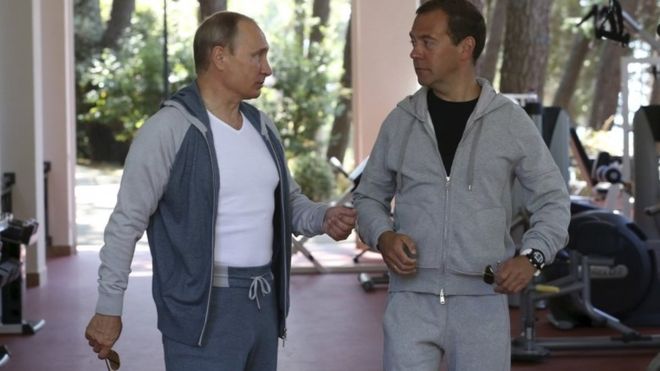
When Vladimir Putin first came to power, he was asked in an interview which of his colleagues he trusted most.
He named five people:
Nikolai Patrushev
Sergei Ivanov
Dmitry Medvedev
Alexei Kudrin
Igor Sechin
Fifteen years later, these men still form President Putin's core group and dominate the strategic heights of Russian government and big business:
Mr Patrushev was director of the FSB internal security service from 1999 until his appointment as Secretary of the Russian security council in 2008
Mr Ivanov has been Defence Minister and Deputy Prime Minister. Since 2011, he has been head of the presidential administration
Mr Medvedev was President from 2008-12, forming part of the ruling "tandem" with Mr Putin, and is now Prime Minister
Mr Kudrin, Finance Minister until 2011, no longer holds a formal position but still appears to offer advice to the president on financial and economic matters
Mr Sechin, who has held senior positions in the presidential administration and government, is chief executive of Rosneft, the state oil company
This core group illustrates two important points about who runs Russia.
First, there has been continuity in terms of the personnel closest to Mr Putin. Real reshuffles are rare, and very few have been evicted from this core group.
Second, the heart of the leadership team is made up of allies who served with Mr Putin in the KGB, in 1990s St Petersburg, or both.
This core group also includes others whom the president trusts to implement major infrastructure projects, such as Arkady Rotenberg, one of those responsible for the Sochi Winter Olympics, as well as several regional figures and senior bureaucrats.
Many of these figures held senior positions even before Mr Putin's rise to power.
Defence Minister Sergei Shoigu, formerly Minister of Emergency Situations, was a prominent party political figure in the second half of the 1990s and leader of the United Russia party from 2001-05.
Such figures convene in the security council, one of the most important organisations for co-ordinating high-level decision-making and resources.
At the same time, the Russian administrative system - the so-called vertical of power - does not function well: policy instructions are often implemented tardily and sometimes not at all, so others have important roles helping develop and implement projects.
One such individual is Yuri Trutnev, elected as a regional governor in 2000, and then appointed Minister for Natural Resources and Ecology in 2004.
In 2013, he was promoted to Deputy Prime Minister and Presidential Plenipotentiary to the Russian Far Eastern Federal District, a high priority post for Mr Putin.
Russian observers also point to the role played by Vyacheslav Volodin in helping Mr Putin run Russian politics since 2011.
Mr Volodin rose through regional and then national party politics, before being appointed to government positions.
He established the influential All-Russian Popular Front in 2011, which makes an increasingly significant contribution to formulation, implementation and monitoring of the leadership's policies.
Mr Volodin was subsequently appointed First Deputy Head of the presidential administration, responsible for overseeing a "reset" of Russian domestic politics since 2012.
Alongside continuity in the core leadership team, there has been a growing need for effective managers to implement its policies.
Indeed, rather than shrinking, as some commentators have suggested, the leadership team appears to be expanding.There are several rising stars who play increasingly important roles in party politics and administration.
One is 39-year-old Alexander Galushka, who is a member of the Popular Front and many of the president's and prime minister's advisory committees.
He was appointed Minister of the Far Eastern region in 2013.
This leads us to the final point about who runs Russia with Mr Putin - while the President is the central figure, he is part of a team, which itself is part of a system, and therefore highlights the importance of effectiveness in implementing tasks.
All the individuals have reputations for hard work, loyalty and proven effectiveness in completing difficult tasks in business, state administration and politics.
As one Russian close to Mr Putin has observed, he did not choose them for their pretty eyes, but because they get things done.
(BBC)
www.ann.az


Facebook
Follow us on Facebook


Similar news
Similar news





 Photo




 Video


