




Iron meteorites 'buried in Antarctica' by the Sun
17.02.2016 21:30


New research suggests there could be a layer of iron-rich meteorites hidden just under the Antarctic ice.
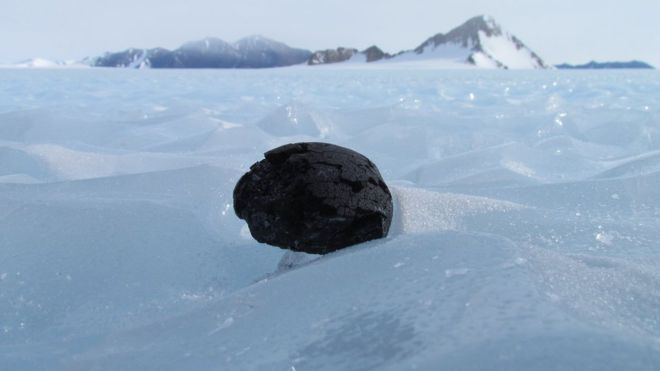
The churning of glaciers spews many space rocks out on to the surface in Antarctica, but compared to elsewhere on Earth, few of them are made of iron.
Based on modelling and lab experiments, scientists say the missing metallic rocks might be burying themselves, by melting the ice as sunlight heats them.
To prove their idea, the team now wants to look for the rocks themselves.
"The study is proposing a hypothesis - these samples should be there. We just have to go and locate them," said Dr Katherine Joy from the University of Manchester, a co-author of the paper published in Nature Communications.
Antarctica is known by meteorite specialists as a fruitful hunting ground, because the rocks are collected from their landing sites by glacial flows and transported to concentrated dumping-grounds.
"The great thing about Antarctica is they fall on the ice, and then the ice progressively moves away from the plateau. And where it hits these barriers, along the Transantarctic Mountains, the ice gets moved up," Dr Joy told the BBC.
"So this continuous conveyor belt has delivered meteorites from the interior fall sites to the 'meteorite stranding zones' for the past couple of million years or so."
Among this Antarctic haul, however, researchers have noticed that iron-rich meteorites - whether partly or wholly made of the metal - are surprisingly scarce, compared to the percentage collected in other places around the world.
Dr Joy and her colleagues think they may have discovered why.
They froze two small meteorites of similar size and shape, one rocky and one iron, inside blocks of ice and then heated them using a lamp to mimic the Sun.
Both meteorites, on repeated trials, melted their way downward through the ice block. But because the metal conducts heat more efficiently, the iron meteorite sank further, faster.
The researchers then expanded that observation using a mathematical simulation. Their model showed that this Sun-driven burrowing would be enough to cause iron-rich rocks to sink so much during the long summer days that, over the course of the year, it would account fairly precisely for the lack of iron space rocks welling their way to the surface of the Antarctic "stranding zones".
"The idea is, they never make it to the surface. They're forever trapped, 50-100cm or so below the ice," Dr Joy explained.
That means, if the team's findings are to be believed, that the hunt is on.
Failed planets
As Dr Joy's Manchester colleague Geoffrey Evatt put it: "The challenge is now set - to be the first team to locate this reserve of meteorites and retrieve samples from it."
Of all the meteorites gathered from Antarctica, only a handful - so far - have been pulled out from beneath the ice. This is mostly for practical reasons, Dr Joy said.
"When it's very cold... picking up the sample in a controlled way is difficult enough with things sitting on the surface. To access ones that are subsurface - nobody's really tried to do that so far."
So it will not be easy, but the team hopes that radar and metal detectors might help target the search. And the potential rewards are high.
"Every meteorite we find tells us something new about the Solar System," Dr Joy said.
Some are carbon-rich or rocky remnants from long before any planet clumped together; others - like iron and rocky-iron meteorites - offer clues from a more intermediate stage, when baby planets with cores, mantles and crusts were trying to form.
"The iron group represents meteorites that were once the cores and the internal structures of different planetesimals.
"We think there were probably hundreds of these early planets, that formed in the solar system but never really got big enough and were broken up in collision events."
(BBC)
www.ann.az


Youtube
Follow us on Youtube


Similar news
Similar news












 Photo




 Video


