





Shooting IS in the cash register
03.05.2016 16:31


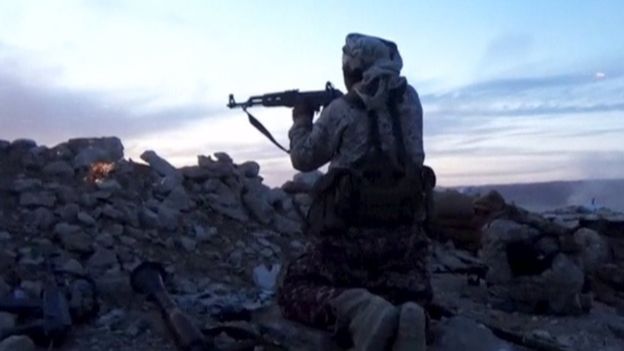
There is more than one way to kill an army. And a recent US Defense Department briefing by Maj Gen Peter Gersten revealed a new one - shoot it in the cash register.
The general is the deputy commander of Operation Inherent Resolve - the campaign against so-called Islamic State (IS) in Iraq and Syria. He recounted an air attack against what he described as a bulk cash storage facility in the Iraqi city of Mosul.
It was the base for one of IS's key local financial figures responsible for distributing cash to its fighters throughout the area. The general claimed that when the building was destroyed it contained about $150m (£103m). He said the Americans even knew which precise room the funds were in.
This incident in itself is not going to win any war. But it is highly indicative of a new phase in the campaign against IS which exploits its vulnerabilities - ones that have become clearer as the air campaign has worn on.
Of course it is still far too early to look towards an ending of the air campaign. IS remains a resilient foe. And it looks set to inspire its sympathisers abroad for the foreseeable future.
But while analysts have tended to focus on IS's tactical losses, the impressive performance of Kurdish Peshmerga fighters, or the improving - though still mixed - capabilities of the Iraqi military, a rather different battle has been under way - and one that IS is clearly losing.
The clue is in the organisation's name itself: the so-called "Islamic State". We use "so-called", I suppose, because few people want to give credibility to the organisation's Islamic credentials.
But its pretentions to be a "state" should be taken more seriously:
it controls a swathe of territory
it has a population (willing or otherwise)
it has to raise revenue and make payments
Fighting shadowy Islamist groups is one thing for a Western-style military machine. But taking down a state - even a pseudo-state - is quite different. That the Americans are rather good at.
The longer this campaign goes on, so the more intelligence is available, the greater the Pentagon's understanding of the structure of the IS edifice, and the better the Americans' ability to take it down.
The strikes against IS's cash reserves are part of a carefully choreographed strategy to target IS's economic underpinnings. They follow a campaign against oil facilities - one of the organisation's key sources of revenue.
There is also a widespread cyber and electronic campaign against IS both tactically using specialised warplanes to jam communications as well as a more strategic effort that is only hinted at in the US briefings. A significant goal of this operation must be to hit the cohesion of the IS "state" itself.
Well-sourced reports in the US say that the 50 or so American special forces already in Syria have launched multiple raids killing a significant number of IS operatives - especially people linked with overseas recruitment and operations abroad.
This too hints at an accumulating "knowledge base" of intelligence that is enhancing the effectiveness of the Pentagon's campaign. This is the context in which the latest announcements of US reinforcements should be seen, not least the 250 additional special operators going into Syria.
The upshot of this financial targeting and cyber-warfare? The Americans claim that IS is having to reduce payments to its fighters, and also that the flow of foreign recruits to join the group's ranks is reducing.
That said, the war is far from over. Indeed you might ask which war? The struggle in Syria between President Bashar al-Assad and rebel forces, including Islamists like the Nusra Front and IS, looks ready to escalate. The US-led coalition's war against IS in Iraq is also making sometimes stuttering headway.
But the recently revealed details of this one strike against a cash facility have illuminated something of the broader campaign that was obscured by the daily litany of strikes against fighting positions, bunkers and so on.
IS's ideology may be very difficult to defeat. But its strategic choice - to seize territory and de facto to become a country - may in retrospect prove to be its biggest mistake.
That of course does not mean there is going to be anything like an easy victory. Progress on the battlefield (regaining territory) is all very well but if peace and stability are to be restored there has to be capable and representative governance. Establishing this in Iraq will be a long-term struggle.
Getting any kind of governing formula in Syria will be even more difficult. Who will then pay for rebuilding and reconstruction, and the return of huge numbers of displaced people and refugees? Who will pay to rebuild something of Syria's shattered infrastructure and economy?
There is now clear progress in the US-led campaign against IS. But this may only be a preliminary to the greatest test of all - rehabilitating a shattered country. And that's a job that nobody has even begun to think about.
(BBC)
www.ann.az


Instagram
Follow us on Instagram
Similar news
Similar news








 Photo




 Video


