




How China's trawlers are emptying Guinea's oceans
08.07.2016 12:31


Chinese fishing vessels operate illegally off the coast of Guinea, depleting its fish population and destroying marine life. Despite the economic and social consequences of illegal fishing, the Guinean government has failed to police its waters because it doesn't have money to operate surveillance equipment, as the BBC's Tamasin Ford reports.
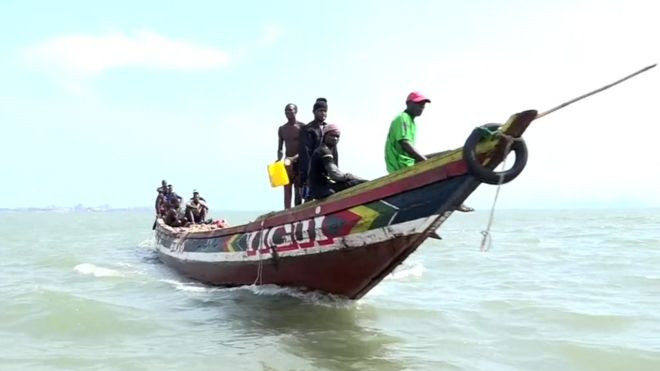
Abdoulaye Soumah looks out to sea as fishermen bring in the day's catch. Their brightly coloured traditional wooden boats glide into Bonfi port in Conakry, Guinea's capital, where men wait to load the fish into baskets.
"We used to get between $700 (£540) and $1,400 worth of fish a day," says the 32-year-old fisherman.
"But now, because of the increase in illegal fishing, there are fewer fish," he says angrily.
"The same catch will now get around $140 because there's no fish in the zone we normally fish in."
And the waters off West Africa have the highest levels of illegal catch in the world, according to the UK-based non-profit organisation, the Environmental Justice Foundation (EJF).
More than a third of all fish caught in the region is illegal, unreported or unregulated, it says.
"These illegal pirate fishing operators are in effect stealing from some of the poorest people on our planet to provide short-term profit to wealthy fishing operators," says EJF head Steve Trent.
He explains how a mixture of poor governance, limited resources and corruption create a situation ripe for exploitation. And Guinea is one of the worst examples.
It's the only country in Africa banned from exporting fish to Europe; the world's biggest market.
Levels of illegal fishing are just too high and the EU says the Guinean government "hasn't shown the necessary commitment to reforms."
The most prized fish in Asia
At the fish market in Conakry, Aboubacar Kaba, head of the Artisanal Fisheries Union, grabs a silver fish about the size of his forearm from the back of a refrigerator truck.
"This is the most prized fish in Asia; the yellow croaker," he says, claiming this is what the illegal trawlers are after.
The fish is now classified as endangered and has reportedly disappeared from Chinese seas because of overfishing.
"In 2008 there were 14 Chinese trawlers in these waters," he says. "We're now in 2016 and there are close to 500 trawlers all searching for this species of fish."
And, according to Greenpeace, many of these companies have a history of illegal fishing in the region.
Hundreds of incidents of illegal activity by Chinese trawlers have been documented in West Africa over the years.
Trawlers took advantage of Ebola
Illegal fishing in Guinea got even worse as the country was battling the deadly Ebola virus, according to a Greenpeace investigation.
"During the Ebola outbreak, the country focused all their resources and capacity to deal with Ebola," says Ahmed Diame, the Africa Oceans campaigner at Greenpeace.During a month-long mission at the end of 2014 while Ebola was ravaging the country, a Greenpeace ship spotted an illegal Chinese trawler once every two days.
"In this investigation we discovered that some Chinese vessels fishing in West Africa under-report their gross tonnage and this has many implications of course, including loss of revenue to the state," says Mr Diame.
Most of the Chinese vessels are known as bottom trawlers; banned in some parts of the world because they are so destructive.
They scrape up everything from the bottom of the ocean, ripping up coral and oyster beds, taking with them everything in their path.
"Up to 90% of the catch can be thrown back into the sea often already dead," according to Greenpeace.
It means fish stocks are rapidly disappearing from West African waters. But while Guinea managed to officially rid the country of Ebola in June, illegal trawlers are still being spotted.
"This is where we see them, late at night," says Mr Soumah as he takes me into the artisanal fishing zone on his wooden motorised boat.
The area stretches 12 miles from the shore and is exclusively reserved for artisanal fishing on small boats like these.
Industrial fishing is forbidden in order to protect the fish stocks.
'I'm scared'
The Environmental Justice Foundation has evidence, yet to be published, that proves illegal, unreported and unregulated fishing is still going on in these waters.
Similarly, Greenpeace also started another investigation in January this year across Cape Verde, Mauritania, Gambia, Guinea, Guinea Bissau, Sierra Leone and Senegal.
It will take three years, but the organisation hopes it will get a more detailed analysis of the situation.
The issue of the lack of resources couldn't be made clearer as I visit Conakry's Maritime Authority.
The Rear Admiral unlocks a door at the back of his office. Members of the navy and maritime surveillance team sit among impressive looking equipment.
This is where they monitor Guinea's waters.
The problem, says the deputy commissioner, as he shows me some of the brand new kit delivered by the EU, is that they have never been able to use it.
The subscription to the satellite system that drives the equipment costs 10,000 euro ($11,000; £8,500) a year and they just don't have the money.
The government says it is trying but without resources, it's an uphill battle.
Guinea recently signed a treaty to crack down on illegal fishing but it is too early to say what effect it will have.
High hopes rest on Andre Loua, the new Minister of Fisheries, who was appointed earlier this year.
"Yes, I'm very scared if we don't halt illegal fishing," he says frankly.
"The direct consequences of illegal fishing is the destruction of fish stocks and that's why the government has taken every opportunity to show it's willing to fight this practice and we are going to keep going until we eradicate illegal fishing in this zone."
But back on Mr Soumah's boat at Bonfi port, these feel like empty words.
"The next generation doesn't stand a chance," he says bleakly. "Listen, our children survive on what we do."
Illegal fishing is slowly destroying an already fragile economy here.
Mr Soumah thinks the future of his children is dire.
"Fishing enables us to educate our children, feed them and provide for their healthcare. So if the illegal fishing directly affects us as fishermen, what do you think the impact is on our children?"
(BBC)
www.ann.az


Telegram
Follow us on Telegram


Similar news
Similar news








 Photo




 Video


